Cloud security automation enhances a business’s ability to protect sensitive data and applications in cloud environments. Automated security measures enable real time defense against cyber threats, improving operational efficiency and strengthening the security posture. As of 2026, best practices focus on AI readiness, multilayered frameworks, and rapid remediation. Enterprises that implement cloud security automation report significant ROI, saving up to 19 hours per week and reducing breach response times (Source: recent studies). Veritis offers strategic cloud security automation services, helping organizations achieve resilience and agility in the digital space.
As businesses move to cloud platforms, security automation becomes essential to safeguard data and applications. Despite the cloud’s inherent advantages, security concerns can hinder adoption. According to 2026 insights, enterprises using cloud security automation face challenges in reaching full automation maturity but experience substantial ROI, with payback periods of less than six months. Automation boosts operational efficiency, saving enterprises 19 hours per week.
Speak with an Cloud Security Expert
What is Cloud Security Automation Important?
Cloud security automation is crucial because it reduces human error, speeds incident response, and supports regulatory compliance. As cloud environments grow more complex, automation enables real time threat detection and integrates effectively with other security solutions, strengthening the security framework.
What You’ll Learn from this Guide
In this guide, you’ll explore the fundamental elements of cloud security automation, including the latest best practices, strategic implementation frameworks, and how automation can drive business efficiency. Gain insights into how leading companies implement these strategies to achieve remarkable security transformation.
5 Steps for Successful Cloud Security Automation
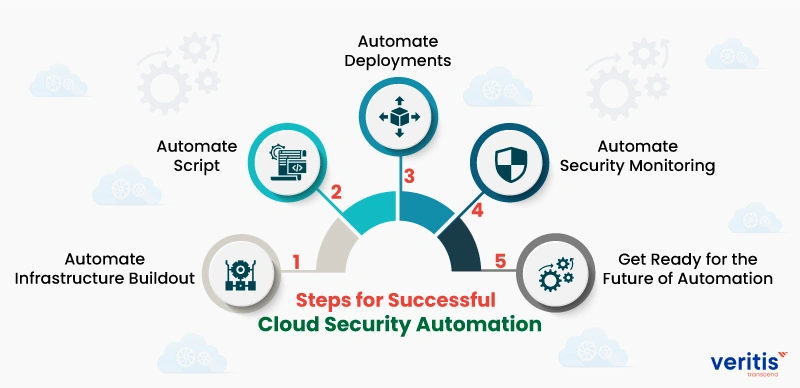
Here are five cloud security automation best practices for the successful implementation of cloud security automation:
1) Automate Infrastructure Buildout
Automating infrastructure buildout reduces manual configuration, minimizing security mistakes and streamlining the automation process.
2) Automate Script
Automation scripts streamline operations by reducing manual interventions for zero day vulnerabilities or security updates.
3) Automate Deployments
Deployment automation aligns with DevOps best practices, enabling rapid responses to security threats and maintaining a consistent security posture.
4) Automate Security Monitoring
Automating security monitoring provides intelligence for efficient threat resolution, securing critical assets across hybrid environments.
5) Get Ready for the Future of Automation
Preparing for future automation needs ensures that your team can handle comprehensive process automation effectively.
Useful Link: How Cloud Automation is Driving DevOps Efficiency?
5 Stages of Cloud Security Automation Framework
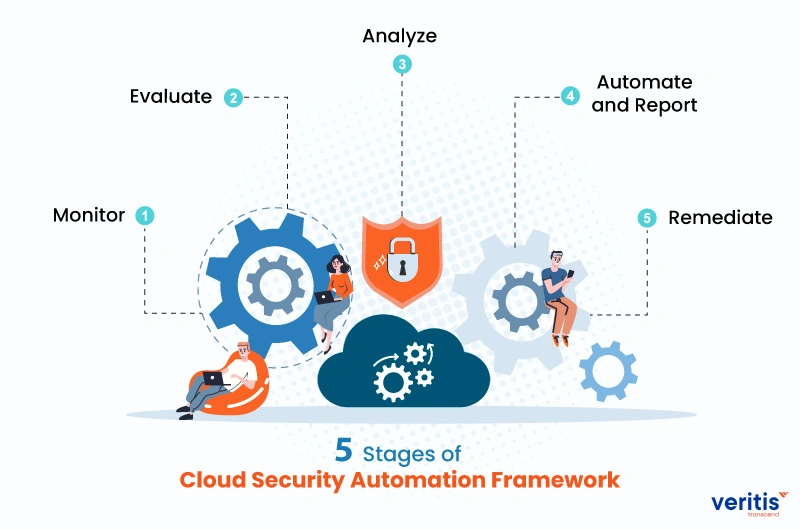
1) Monitor
Monitoring all cloud security operations is essential to understand where workflows excel or need improvement.
2) Evaluate
Identifying and prioritizing automation tasks is fundamental to simplifying cloud security infrastructure.
3) Analyze
In depth data analysis guides improvements and assesses automation’s impact on existing processes.
4) Automate and Report
Automated workflows produce reports that offer critical insights into security changes and improvements.
5) Remediate
Implementing remediation strategies strengthens the security posture and ensures a more robust security framework.
Useful Link: Cloud Infrastructure Automation: The Imperative for Cloud Success!
Benefits of Cloud Security Automation
The benefits of cloud security automation are transformative, providing:
1) Accuracy
Reduces human errors and misconfigurations, leading to consistent security processes.
2) Speed
Facilitates quicker infrastructure provisioning and incorporates security checks early in development.
3) Enhanced Security
Automated responses allow for rapid threat identification and mitigation without reliance on manual monitoring.
4) Compliance
Streamlined compliance processes efficiently verify adherence to regulations.
5) Scalability
Automation provides scalability, enhancing operational flexibility across locations.
A continuous, automated security protects your enterprise’s critical cloud automation assets from evolving threats, as well as helps your business reap the following more benefits:
- Consistency in security operations automation
- Reduced manual errors
- Advanced security measures
- Robust security posture
- Rapidly identify and address security gaps
Useful Link: What is Cloud Security Posture Management?
Best Practices for Cloud Security Automation

1) Automating Configuration Management
Ensures that cloud environments remain securely configured through automated management processes.
2) Automated Vulnerability Scanning
Regular scanning identifies and mitigates potential security weaknesses.
3) Identity and Access Management Automation
IAM automation is vital for maintaining a secure environment and preventing unauthorized access.
4) Automated Patch Management
Continuous patch management prevents security vulnerabilities posed by outdated systems.
5) Log Monitoring and Analysis Automation
Automated log monitoring improves threat detection and enables faster responses.
Useful Link: 8 SaaS Security Best Practices to Secure Applications
Innovative Strategies for Cloud Security Automation

1) Automating Cloud Security Infrastructure for Robust Protection
Continuous management of security protocols through automation strengthens infrastructure against threats.
2) Automating Threat Response With a Cloud Security Strategy
Automation supports rapid threat detection and effective incident responses, integrating with cloud strategies.
3) Streamlining Identity Management With Cloud Security Automation
IAM automation efficiently manages access, helping secure cloud systems.
4) Enhancing Patch Management Through Cloud Automation
Automated patch management adds significant advantages, keeping systems secure.
5) Real time Threat Detection With Automated Log Monitoring
Real time log monitoring provides early threat warnings, enabling swift actions to be taken.
Conclusion
Cloud security automation is pivotal for businesses seeking robust security infrastructure while fostering operational efficiency. Challenges like skill gaps and full automation maturity can be overcome by the substantial advantages it offers, such as significant ROI and time savings. Organizations can optimize their cloud security strategies by partnering with Veritis, an expert in this field.