IT operations teams manage growing volumes of logs, events, metrics, and traces across cloud, hybrid, and distributed environments. AIOps solutions apply machine learning and automation to help teams correlate these signals, identify potential incidents, and prioritize response. When integrated with DevOps practices, AIOps can help reduce manual investigation and give engineers more time to focus on reliability and delivery. Results depend on data quality, operational processes, and how automation is governed.
This article explains how AIOps solutions work, where they intersect with DevOps, the concrete benefits and honest trade offs, and a practical roadmap for integrating AIOps into your existing DevOps pipeline.
Transform IT Operations with AIOps
What is AIOps?
AIOps, AI for IT Operations, applies big data analytics, ML, and automation to improve IT operations management. Gartner coined the term to describe platforms that ingest massive volumes of operational data and surface actionable intelligence in real time.
Large enterprises generate enormous volumes of log, event, metric, and trace data from distributed architectures: containers, microservices, multi cloud environments, and hybrid infrastructure. AIOps platforms can correlate signals across these environments, detect deviations from expected behavior, and help teams investigate likely causes. Their effectiveness depends on the quality and context of the data they receive. Automated remediation should be limited to approved actions with clear escalation paths.
AIOps adoption figures should include a verifiable source, publication date, and population definition. For organizations evaluating AIOps, the more useful starting point is whether they have reliable telemetry, clear service ownership, and operational processes that can act on platform insights.
Core Capabilities an AIOps Platform Must Deliver
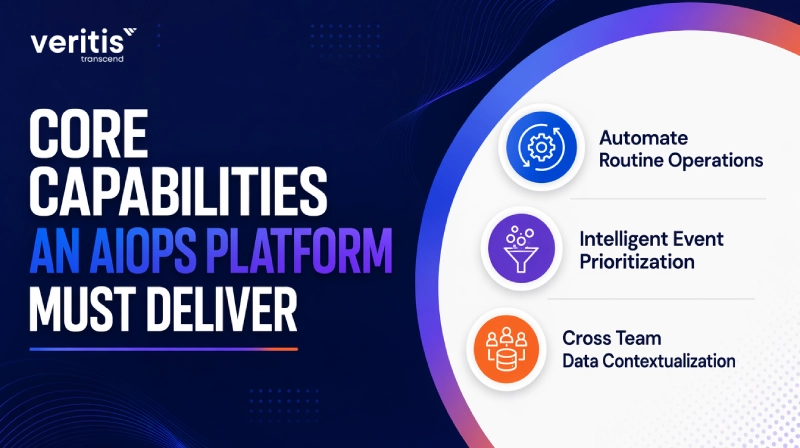
1) Automate Routine Operations
AIOps platforms handle repetitive, rules based tasks that consume engineering bandwidth: fulfilling resource requests, triaging non critical alerts, executing standard runbooks, and managing ticket routing. This frees senior engineers for work that requires judgment.
2) Intelligent Event Prioritization
Human operators monitoring dozens of dashboards will miss subtle signals. An AIOps platform evaluates every event in context.
For example, a platform can compare an event with the system’s normal behavior and related signals to help prioritize investigation. Security teams should apply approved incident response policies before deprioritizing alerts. An event on a low priority asset may still indicate compromised credentials, sensitive data exposure, or movement across systems.
3) Cross Team Data Contextualization
Each IT function security operations, infrastructure, service desk, application teams needs different views of the same underlying data. AIOps learns which metrics and analysis outputs are relevant for each team and delivers contextualized dashboards and alerts, eliminating the manual data sharing overhead that slows incident response.
AIOps does not replace DevOps, observability, or IT service management. Observability provides evidence about system behavior, AIOps analyzes and correlates that evidence, and DevOps teams use the findings to improve delivery and reliability.
For organizations using cloud native pipelines, DevOps automation services can provide a foundation for applying AIOps insights to delivery and operations workflows.
Useful link: AIOPS Solutions: Enhancing DevOps with Intelligent Automation for Optimized IT Operations
What is DevOps and Why Does It Need AIOps?
DevOps is an organizational and technical approach that unifies software development and IT operations. Its goal is to eliminate the friction between teams that build software and teams that run it, enabling faster, more reliable software delivery through automation, continuous integration, and continuous delivery (CI/CD).
The core principles of DevOps are collaboration, automation, measurement, and shared accountability. The measurable outcomes include:
- Faster release cycles with reduced deployment risk
- Improved software reliability and mean time to recovery (MTTR)
- Lower operational costs through automation
- Higher customer satisfaction from stable, responsive applications
As DevOps pipelines mature, they generate increasing volumes of telemetry data from build systems, test environments, staging, and production. Interpreting that data manually becomes a bottleneck. This is where AIOps becomes a force multiplier for DevOps teams, transforming raw operational data into decisions and automated actions.
For organizations using cloud native pipelines, DevOps automation services provide the foundational layer on which AIOps intelligence is applied.
How AIOps Works: The Operational Workflow
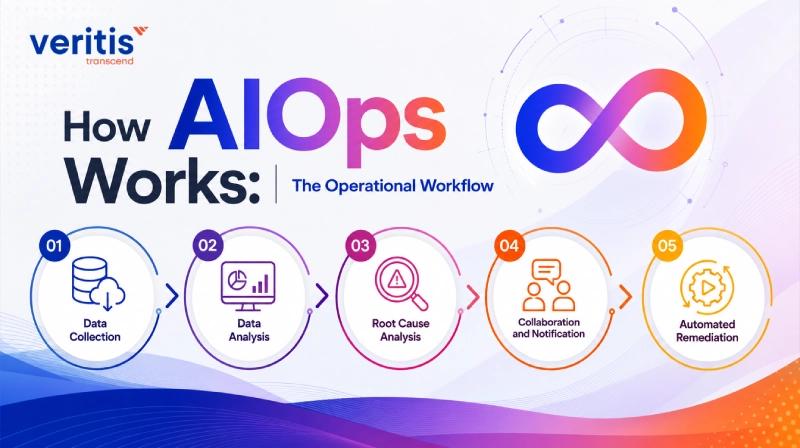
Understanding the mechanism helps IT leaders evaluate vendor claims against operational reality. A production grade AIOps workflow follows five sequential stages:
1) Data Collection
The platform ingests data from every relevant source: application logs, infrastructure events, configuration management databases, network traffic, security logs, incident tickets, and performance metrics. Both structured data (databases, time series metrics) and unstructured data (log files, natural language tickets) are included.
Where operational records are fragmented across legacy and cloud systems, enterprise data integration can help establish a more consistent data foundation. Sensitive fields should be protected or filtered according to organizational policies before data is ingested.
2) Data Analysis
Machine learning models, anomaly detection, pattern recognition, clustering, and predictive analytics continuously process the ingested data. The platform distinguishes genuine anomalies from noise, reducing alert fatigue by correlating related events into a single, contextualized incident record.
3) Root Cause Analysis
AIOps can use service relationships, change records, event timing, and dependencies to identify likely sources of an incident. Correlation helps narrow an investigation, but it does not prove causation. Teams should be able to review the evidence behind a suggested cause, particularly before taking consequential action.
4) Collaboration and Notification
Once the root cause is established, the platform alerts the relevant team with full context: what happened, when, on which systems, and what has already been determined. Event data is preserved for future pattern recognition and post incident review.
5) Automated Remediation
For known issue patterns, AIOps executes predefined remediation scripts without waiting for human intervention, scaling resources, restarting services, rolling back deployments, or isolating compromised components. For novel issues, it routes to the appropriate human with full diagnostic context already assembled.
Start automated remediation with reversible, low impact actions. Each runbook should define its trigger, required permissions, success checks, rollback procedure, and escalation owner.
AIOps Benefits: What Enterprise Leaders Should Expect
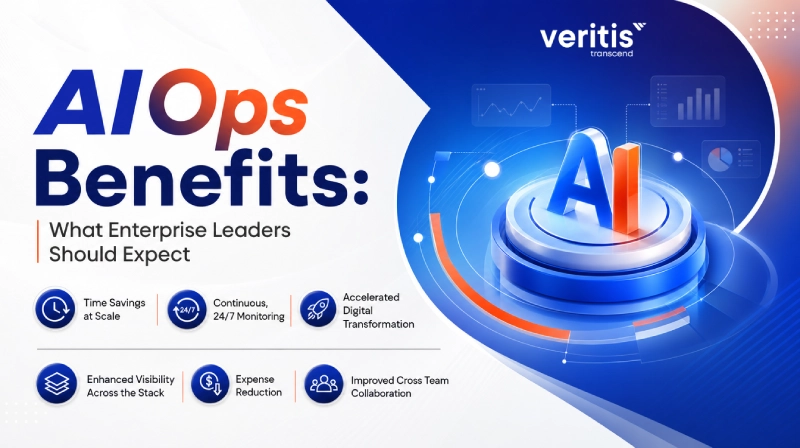
1) Time Savings at Scale
AIOps automates three categories of work that currently consume significant engineering hours:
- Alert triage: Event correlation can help reduce duplicate alerts and manual investigation. Measure the change in your environment alongside missed incidents and service impact.
- Root cause analysis: ML driven diagnosis cuts investigation time from hours to minutes
- Remediation: Automated runbook execution resolves known issues without human escalation
2) Continuous, 24/7 Monitoring
A strong AIOps strategy enables continuous monitoring of infrastructure and applications without interruption. AIOps platforms dynamically maintain behavioral baselines, allowing teams to detect performance degradation, unusual traffic patterns, and emerging security threats before they cause outages. Unlike threshold based alerting, this approach adapts to changing operational conditions in real time.
3) Accelerated Digital Transformation
Enterprises migrating to cloud native architectures face a temporary visibility gap; legacy monitoring tools do not understand containerized, ephemeral workloads. AIOps platforms close that gap by learning the behavior of new infrastructure automatically. Organizations embedding automation services and tools alongside AIOps adoption reduce the operational risk of large scale migration programs.
4) Enhanced Visibility Across the Stack
AIOps provides unified visibility across system performance (CPU, memory, network), application performance (response times, error rates, throughput), and security posture (authentication anomalies, firewall events, lateral movement indicators). A single platform surfacing this data eliminates the blind spots that exist when siloed tools fail to communicate.
5) Expense Reduction
By preventing unplanned outages, automating provisioning, and reducing manual labor in incident response, AIOps delivers a measurable reduction in operational expenditure. Infrastructure rightsizing recommendations driven by AIOps analytics also reduce cloud spend in over provisioned environments.
Validate cost benefits using your own baseline. Include platform licensing, data ingestion and storage, integration, engineering time, and any verified savings from reduced incidents or optimized infrastructure.
6) Improved Cross Team Collaboration
AIOps replaces the ad hoc, meeting heavy collaboration model with structured, data driven workflows. Each team receives relevant insights in context. Shared dashboards and automated reporting give business units visibility into IT performance without requiring translation from engineers.
Useful link: AIOps Use Cases: How Artificial Intelligence is Reshaping IT Management
How Should You Measure AIOps Value?
Agree on a baseline before launching a pilot. Track measures such as time to detect, time to recover, actionable alerts per incident, engineering hours spent on triage, automated resolution rate, and failed automation attempts. Compare results over a consistent period and account for changes in traffic, incident severity, and infrastructure.
Separate cash savings from released engineering capacity and estimated avoided losses. Time redirected from triage to reliability work is valuable capacity, but it is not automatically a payroll saving. An AIOps ROI estimate should identify the benefits that have been verified and the full costs of the program.
Trade Offs: AIOps Drawbacks to Manage
No enterprise technology delivers value without implementation discipline. AIOps introduces four categories of risk that leadership teams should plan for explicitly.
1) Data Quality
AIOps models are only as good as the data they are trained on. Incomplete, stale, or inconsistent telemetry produces inaccurate predictions and missed incidents. Organizations with fragmented monitoring toolchains must invest in data normalization before deploying AIOps at scale. Implement data quality checks and cleansing pipelines as a prerequisite, not an afterthought.
2) Deployment and Integration Complexity
Integrating an AIOps platform with existing ITSM tools, monitoring stacks, CI/CD pipelines, and cloud management platforms is a significant technical program, not a product installation. Organizations without a clear integration architecture and dedicated program resources frequently stall at this stage.
3) Overreliance on Automation
Automating incident remediation without adequate human oversight creates operational risk. When automation fails or misclassifies an incident, the impact can be larger than the original issue. Governance frameworks must define which remediation actions require human approval and at what confidence threshold automation is permitted to act independently.
These controls should also include limited permissions, audit trails, rollback paths, and a clear process for pausing automation when an action fails or produces an unexpected result.
4) Bias and Fairness in ML Models
AIOps models trained on historical data that reflects past operational biases will reproduce those biases in their recommendations. This is particularly relevant in security operations, where biased anomaly detection can result in missed threats or disproportionate alerts. Regular model auditing and representative training data are non negotiable controls.
Integrating AIOps Into Your DevOps Pipeline: A Practical Roadmap
For enterprise IT leaders planning an AIOps integration program, these five strategies drive measurable acceleration of DevOps outcomes.
1) Embrace Automation Systematically
Begin with automating high volume, low judgment tasks: alert routing, ticket creation, and basic remediation. Use the capacity freed by automation to invest in more complex ML driven capabilities. Organizations that have matured their DevOps automation practices find AIOps adoption faster because the data pipelines and toolchain integrations are already in place.
2) Break Down Team Silos Structurally
AIOps only improves collaboration if team workflows are redesigned to consume its outputs. Define shared incident ownership models, cross functional runbooks, and escalation paths that reflect how AIOps routes information before the platform goes live.
3) Implement CI/CD With Observability Built In
CI/CD pipelines that do not emit rich telemetry cannot benefit from AIOps analytics. Instrument every stage of the pipeline build, test, staging, production, and feed that data into the AIOps platform. This enables the platform to correlate deployment events with production incidents and predict release risk before code ships. See how cloud automation drives DevOps efficiency to understand the observability patterns that accelerate this integration.
4) Establish Data Governance Before Scaling
Define data ownership, retention policies, and quality standards for every telemetry source before scaling AIOps ingestion. Organizations that skip this step accumulate technical debt that degrades model accuracy over time and creates compliance exposure, particularly in regulated industries.
5) Invest in Continuous Monitoring With Feedback Loops
AIOps platforms improve with feedback. Build processes that capture false positives, missed incidents, and remediation outcomes, and feed that signal back into model training. Static deployments plateau; actively managed platforms compound their accuracy over time.
For teams seeking to quantify the impact of these investments, measuring DevOps ROI through performance metrics provides a structured framework for demonstrating program value to executive stakeholders.
Before expanding a pilot, compare the results with the baseline and the success criteria agreed at the start. Confirm that improvements in alert handling or recovery time did not come at the cost of missed incidents, unsafe remediation, or higher operating expenses.
AIOps and DevOps in Practice: Automotive Case Study
A global automotive manufacturer partnered with Veritis to modernize its IT operations by integrating AIOps into an existing DevOps environment.
Challenge: The organization was managing IT incidents reactively. Alert volumes had grown beyond the team’s capacity to triage manually, system inefficiencies were slowing DevOps release cycles, and leadership had limited visibility into infrastructure performance across geographic regions.
Approach: Veritis deployed an AI powered AIOps platform integrated with the client’s existing DevOps toolchain. The implementation delivered real time monitoring across the full infrastructure stack, automated anomaly detection calibrated to production baselines, and intelligent incident routing with root cause context assembled before engineer escalation.
Results:
- Significant reduction in mean time to detect (MTTD) and mean time to fix (MTTR) across production incidents
- Measurable decrease in alert noise, enabling the operations team to focus on genuine incidents
- Improved collaboration between IT operations and DevOps engineering teams through shared dashboards and automated reporting
- Enhanced infrastructure scalability and system reliability across regional deployments
[Read the full case study: Transforming Automotive Operations with AIOps
For financial services organizations facing similar operational complexity, Veritis’s cognitive automation engagement demonstrates the same AIOps driven approach applied to financial operations.
AIOps Tools and Platform Selection Criteria
Selecting the right AIOps platform requires evaluating capability fit against your specific operational context. Enterprise IT leaders should assess vendors on:
- Data ingestion breadth: Does the platform natively integrate with your existing monitoring, ITSM, cloud, and security tools?
- ML model transparency: Can the platform explain why it flagged an incident or recommended a remediation action?
- Automation governance: What controls exist to limit automated action to approved parameters?
- Scalability: Can the platform handle your peak telemetry volume without degrading detection latency?
- Time to value: What is the realistic timeline to baseline accuracy in your environment?
For teams evaluating DevOps tools for 2026, AIOps capability is increasingly a selection criterion for the broader toolchain, not a standalone platform decision.
A proof of value should use representative telemetry and incidents from your environment. Ask the platform to reconstruct an incident timeline, explain a likely cause, route the issue to the correct owner, and safely stop or escalate when a remediation action fails. This helps assess operational fit beyond a standard product demonstration.
Useful link: AIOps vs MLOps: Which AI Strategy Delivers the Greatest Business Impact for Enterprises?
Strategic Outlook
The enterprises that will lead their industries over the next five years are building IT operations that learn continuously, respond automatically, and improve compounding over time. AIOps is the enabling layer that makes that possible. Integrated with a mature DevOps practice, it transforms IT operations from a cost center managing incidents into a strategic asset accelerating delivery.
The barriers to adoption data quality, integration complexity, and governance discipline are real. But they are engineering problems with known solutions. Organizations that treat AIOps adoption as a program, not a product purchase, and invest in the foundational data and process work realize durable competitive advantage.
Veritis brings the delivery experience to make that program succeed, from AIOps platform selection and integration through governance design and continuous optimization. As a Stevie Award winning IT partner, Veritis has deployed AIOps solutions across automotive, financial services, and enterprise technology environments, with measurable outcomes at each stage.
The business case should center on operational outcomes that teams can verify: improved incident response, reliable automation, and clearer ownership of service performance and cost.
Ready to assess your AIOps readiness?
Explore Veritis AIOps services to discuss platform selection, integration, governance, and ongoing optimization.