For enterprise leaders, the question is no longer whether to adopt AI; it is whether your organization can absorb the risks that come with it. A single flawed algorithm cost Dutch tax authorities their public trust and triggered one of Europe’s most damaging government scandals. Samsung lost control of sensitive IP within weeks of deploying a generative AI tool. These are not edge cases; they are previews of what inadequate AI risk management looks like at scale.
The upside is real. McKinsey estimates that generative AI alone could unlock between USD 2.6 trillion and USD 4.4 trillion in annual value across industries. But Gartner’s data adds a critical condition: organizations that build secure, trustworthy AI infrastructure are 50% more likely to achieve successful AI adoption and meet their business objectives. The takeaway for C-suite leaders is clear: AI risk management is not a compliance checkbox. It is the strategic foundation that determines whether your AI investments deliver or destroy value.
This article breaks down the core risk categories, explains how a structured AI risk management framework protects and accelerates your organization, and outlines the governance practices that separate resilient AI adopters from cautious bystanders.
Schedule an AI Risk Assessment
What is AI Risk Management?
AI risk management is the discipline of identifying, assessing, and mitigating the risks associated with developing, deploying, and operating artificial intelligence systems. An effective AIOps strategy strengthens this discipline by addressing technical vulnerabilities, data governance, model behavior, regulatory compliance, and ethical accountability.
A useful working definition expresses AI risk mathematically:
AI Risk = Probability of AI Failure or Exploit × Impact of the Failure or Exploit
This framing matters because it gives risk teams two clear levers: reduce the likelihood of failure, and limit its blast radius when failure occurs.
Common AI failure modes include:
- Arbitrary code execution
- Data poisoning
- Prompt injection
- Model extraction
- Hallucinations and data drift
- Biased or toxic output
- Unexpected model behavior
The impact of any one of these failures varies by application. Still, consequences routinely include financial losses, regulatory penalties, reputational damage, and direct harm to individuals through wrongful decisions on credit, healthcare, or benefits.
Effective AI risk management also means establishing the processes and governance structures that ensure AI systems adhere to ethical guidelines, legal standards, and internal policy, not just during deployment, but continuously throughout the model lifecycle.
5 Primary AI Risk Categories Every Enterprise Must Address

When evaluating any AI system, five risk dimensions require structured assessment and active mitigation.
1) Operational Robustness
This risk concerns whether an AI system will hold up under unexpected conditions or deliberate adversarial attacks. For systems where failure means financial loss or harm to individuals, robustness is non negotiable.
Mitigation strategies:
- Enhance model generalization across diverse data inputs
- Retrain regularly with updated, representative datasets
- Implement adversarial training and continuous performance monitoring
2) Fairness and Bias
AI systems that treat demographic groups differently create legal exposure and reputational harm. Bias often enters through training data and goes undetected without structured testing across population segments.
Mitigation strategies:
- Audit training data for representation gaps
- Adjust model algorithms to reduce discriminatory outcomes
- Conduct ongoing fairness evaluations against defined benchmarks
3) Privacy and Data Security
AI systems that process sensitive or personal data carry significant legal and ethical exposure. A breach does not just trigger regulatory penalties; it erodes the customer trust that enterprise brands depend on.
For organizations managing identity and access management risk assessment, this category intersects directly with AI governance obligations under frameworks like GDPR and CCPA.
Mitigation strategies:
- Minimize stored data to what is strictly necessary
- Anonymize or pseudonymize personal information at ingestion
- Evaluate federated or decentralized learning architectures
4) Explainability and Transparency
When AI makes consequential decisions loan approvals, healthcare triage, fraud flags stakeholders need to understand why. Black box models undermine trust and complicate regulatory audits.
Mitigation strategies:
- Prioritize interpretable model architectures where performance trade offs are acceptable
- Invest in AI explanation tooling for post hoc interpretability
- Maintain thorough model and data documentation
5) Performance and Efficacy
An AI system that degrades silently is a strategic liability. Performance risk covers model accuracy, precision, recall, and the system’s ability to deliver against its original business goals over time.
Mitigation strategies:
- Define success metrics before deployment, not after
- Implement automated performance monitoring with alert thresholds
- Collect and integrate new data continuously to sustain model relevance
Useful link: Why Every Enterprise Needs Identity and Access Management Risk Assessment?
Understanding the 4 Core Risk Domains in AI Systems
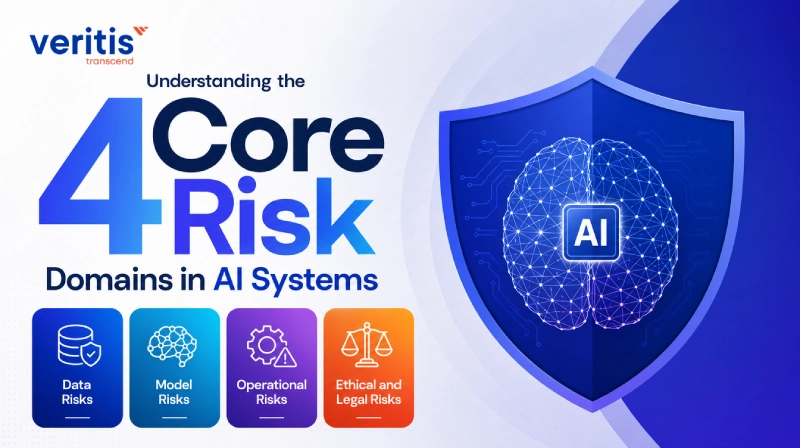
Beyond the five primary risk categories, AI systems generate risks across four operational domains. Each requires distinct governance approaches.
1) Data Risks
Data is the foundation of every AI system, and the AI maturity model helps organizations evaluate whether their data quality, security, and provenance are strong enough to support reliable model outputs.
A) Data Security
Data security is a core component of AI cybersecurity, protecting AI systems and training datasets from unauthorized access, manipulation, and data theft. Encryption, access controls, and secure data storage are essential requirements for maintaining the integrity and confidentiality of AI environments.
B) Data Privacy
Data privacy means ensuring that the collection, storage, and processing of personal information complies with applicable law. Violating data protection standards, whether GDPR, HIPAA, or state level regulations, exposes organizations to penalties and erodes customer confidence.
C) Data Integrity
Data integrity means the data feeding AI models is accurate, consistent, and validated. Without rigorous data cleaning and audit processes, models produce errors that cascade into flawed business decisions.
Organizations operating in cloud environments should evaluate cloud security posture management tools as a structural control for data security across AI workloads.
2) Model Risks
AI models are the analytical core of every AI system. When they are compromised, the entire value proposition of the investment collapses.
A) Adversarial attacksinvolve feeding manipulated inputs to produce incorrect outputs, a well documented attack vector against production ML models. Adversarial training and anomaly detection are primary defenses.
B) Prompt injectionsare a particular concern for large language models, where crafted inputs can bypass safety guardrails and trigger unintended behavior. Input validation and continuous monitoring reduce this exposure.
C) Model interpretabilityaffects both trust and troubleshooting. When models cannot explain their outputs, accountability gaps emerge, especially in regulated industries.
D) Supply chain attackstarget third party components and dependencies embedded in AI systems. Vendor vetting, software bill of materials (SBOM) practices, and ongoing supply chain monitoring are essential controls.
3) Operational Risks
Operational risks arise when integrating artificial intelligence in business environments, where real data, real users, and real consequences interact directly with model outputs.
A) Model Drift
Model drift occurs when the statistical relationship between input data and correct outputs shifts over time. A model that was accurate at launch can become dangerously unreliable within months without continuous monitoring and retraining.
B) Integration Complexity
Integration complexity is a persistent challenge. AI systems must communicate with legacy infrastructure, enterprise databases, and third party platforms. Phased implementation and rigorous integration testing reduce deployment risk.
C) Sustainability
Sustainability is an emerging operational concern. Large scale AI deployments carry significant energy costs. Responsible enterprises are beginning to factor carbon footprint into AI infrastructure decisions.
D) Accountability Gaps
Accountability gaps occur when it is unclear who owns AI driven decisions or their consequences. Clear governance structures, defined roles, and documented escalation paths are essential.
For teams where AI operations intersect with security response, being security incident response ready is a prerequisite , not an afterthought , when AI driven anomalies surface in production environments.
4) Ethical and Legal Risks
The regulatory landscape for AI is tightening globally. The EU AI Act, sector specific guidance from US financial regulators, and evolving state level privacy laws are all moving in the same direction: toward mandatory accountability for AI driven decisions.
A) Lack of Transparency
Lack of transparency in AI decision making creates both regulatory and reputational exposure. Stakeholders, regulators, customers, and employees increasingly expect to understand how consequential AI decisions are reached.
B) Algorithmic Bias
Algorithmic bias that disadvantages protected groups creates direct legal liability in hiring, lending, healthcare, and benefits administration contexts. Diverse training datasets and systematic fairness audits are the primary controls.
C) Non Compliance
Non compliance with data protection and AI specific regulations carries financial penalties and operational restrictions. Staying current with the regulatory environment is now a continuous obligation, not a periodic review.
D) Ethical Dilemmas
Ethical dilemmas, situations where AI produces technically correct but morally questionable outcomes, require governance structures that go beyond legal compliance. Organizations need documented ethical principles, review processes, and escalation paths for contested decisions.
Identity governance and administration frameworks increasingly intersect with AI ethical risk management, particularly where AI systems control access to sensitive data or services.
How AI Risk Management Strengthens Enterprise Performance?

Organizations that treat AI risk management as a strategic function rather than a compliance burden gain measurable competitive advantages. When supported by AI for IT operations, a structured risk framework delivers value across six critical dimensions.
1) Strengthened Security Measures
AI risk management identifies vulnerabilities before adversaries do. By systematically assessing exposure to data breaches, adversarial inputs, and unauthorized access, organizations can close security gaps proactively rather than reactively. Enhanced AI security protocols protect both organizational assets and the integrity of the models that drive business decisions.
For enterprises running containerized AI workloads, reviewing container security risks and best practices is a practical starting point for hardening the infrastructure layer.
2) Enhanced Decision Making
AI systems that operate within a risk management framework produce more reliable outputs. Mitigating data quality issues, model biases, and algorithmic errors means that AI generated insights can be trusted and acted upon with greater confidence. The downstream effect is better business decisions at speed and scale.
3) Ensured Regulatory Compliance
The regulatory environment for AI is not static. Data protection laws, sector specific AI guidance, and cross border compliance obligations all require ongoing attention. A well designed AI risk management framework embeds compliance monitoring into the model lifecycle, reducing the risk of penalties and enabling faster response when regulations change.
4) Boosted Operational Resilience
Operational resilience is the ability to absorb disruption and keep running. AI risk management contributes directly by identifying failure modes before they escalate, enabling continuous monitoring, and ensuring that models are retrained and updated as conditions change. Organizations with mature AI risk practices are better positioned to maintain operations through incidents that would sideline less prepared competitors.
5) Increased Trust and Transparency
Enterprise AI adoption depends on stakeholder trust, from customers whose data is processed, to regulators who oversee outcomes, to employees who act on AI recommendations. Demonstrating rigorous AI risk management practices, transparent decision making, fairness testing, and explainability is increasingly a differentiator in competitive markets.
6) Continuous Testing and Monitoring
AI systems do not stay accurate by default. Continuous testing, validation, and monitoring are not optional maintenance tasks; they are the mechanism by which risk management delivers ongoing value. Automated monitoring systems that detect performance degradation, data drift, or anomalous behavior allow organizations to act before issues escalate into incidents.
Connect with Our AI Risk Specialists
Building an AI Risk Management Framework: Key Components
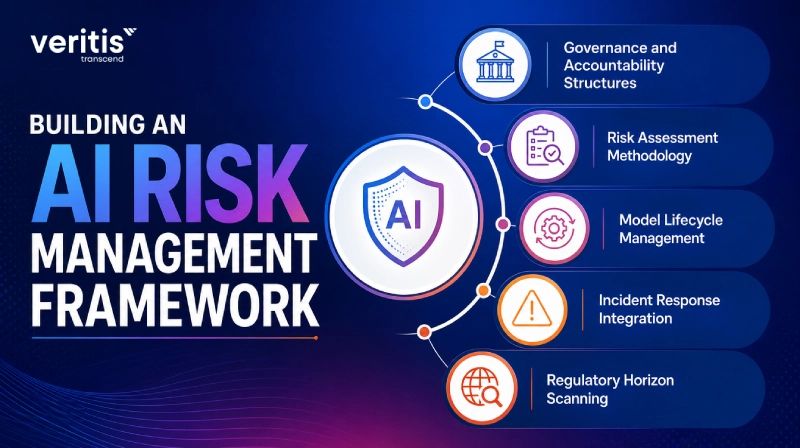
A strong AI risk management framework is not a single tool or policy. It is an integrated governance architecture that spans strategy, operations, and technology.
1) Governance and Accountability Structures
Define clear ownership for AI risk. Assign accountability at the executive level, whether through a Chief AI Officer, a dedicated AI Risk Committee, or integrated responsibility within existing CISO and CTO functions. Without clear ownership, risk management becomes advisory at best.
2) Risk Assessment Methodology
Deploy a systematic approach to identifying and scoring AI risks before deployment. Use the probability × impact model to prioritize effort. Not every AI system carries equal risk; a recommendation engine and a credit decisioning model require very different levels of governance rigor.
3) Model Lifecycle Management
Risk management must span the entire model lifecycle: data sourcing, training, validation, deployment, monitoring, and decommissioning. Each stage carries distinct risks. Organizations that only govern AI at deployment miss the majority of the risk surface.
4) Incident Response Integration
AI specific risks require AI specific incident response protocols. Define escalation paths for model failures, data breaches, and adversarial incidents. Ensure that AI operations teams are integrated with broader security operations, so AI triggered alerts receive an appropriate response at speed.
5) Regulatory Horizon Scanning
Build a process for tracking AI relevant regulatory developments, EU AI Act implementation timelines, US federal guidance, and sector specific rules from financial and healthcare regulators. Compliance should be a continuous capability, not a point in time audit.
Useful link: How Leading Enterprises Use Applied Generative AI for Digital Transformation?
Case Study: AI Driven Incident Management in E-Commerce
A large e-commerce platform approached Veritis with a recurring operational challenge: frequent system outages and slow incident response times were creating compounding security and customer experience risks.
Challenge: The organization lacked the real time visibility needed to detect anomalies before they escalated into outages. Incident response was reactive, manual, and slow, leaving security vulnerabilities open for extended periods.
Solution: Veritis deployed an AI driven AIOps platform providing real time monitoring, automated anomaly detection, and proactive incident resolution. The solution was integrated with existing infrastructure to ensure continuity and minimize deployment risk.
Results:
- 70% faster incident resolution, directly reducing the window of security vulnerability
- Real time anomaly detection replaced reactive monitoring, enabling proactive risk mitigation
- Measurable improvement in system reliability and reduction in operational risk exposure
This engagement illustrates the central thesis of AI risk management: when AI is deployed within a structured risk and governance framework, it does not just manage risk; it actively reduces it while accelerating operational performance.
Read the Full Case Study: Revolutionizing Incident Management With AIOps in E-commerce Platform
Conclusion: Risk Management Is the Precondition for AI Driven Growth
In 2025, AI adoption is not optional for enterprises that intend to remain competitive. But adoption without governance is a liability, not an advantage. The organizations that will lead their sectors are those that treat AI risk management as a strategic capability, not a compliance cost.
Addressing data, model, operational, ethical, and legal risks systematically enables enterprises to protect their assets, accelerate decision making, maintain regulatory standing, and build the stakeholder trust that sustained AI adoption requires.
At Veritis, we bring the operational experience of an enterprise scale AI and AIOps practice to every engagement. As Stevie Award and Globee Award winners, our AI risk management frameworks are designed to deliver measurable outcomes, not theoretical governance documents. We work with mid to large enterprises to build secure, resilient, and high performing AI environments that turn risk discipline into competitive advantage.
Contact Veritis today to discover how our AI risk management and AIOps services can help your organization navigate this environment and achieve its strategic objectives.