For small and medium sized enterprises, the margin between growth and stagnation often comes down to infrastructure decisions made today. Adopting a cloud strategy has shifted from a cost saving initiative to a strategic business priority, helping SMEs reduce operational overhead, accelerate innovation, and compete with enterprises that outspend them by orders of magnitude. This article explores how cloud based solutions deliver measurable advantages for SMEs and what it takes to implement them successfully.
What is Cloud Computing?
Cloud computing is the on demand delivery of computing services, storage, processing, software, and networking, over the internet, typically on a pay as you go basis. Instead of investing in physical servers and premises infrastructure, SMEs pay only for what they use when they use it. That model alone changes the economics of IT for growing businesses.
Modern cloud environments allow teams to access data and applications from any device, anywhere, a capability that has become table stakes in today’s distributed work environment.
Types of Cloud Computing Services
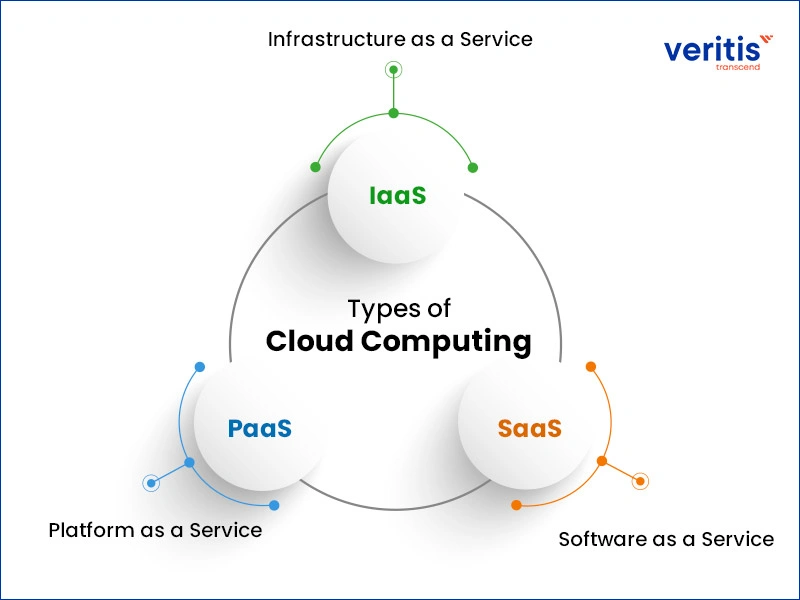
Cloud computing is built on three foundational service models. Understanding each helps SME leaders make informed procurement and architecture decisions.
1) Platform as a Service (PaaS)
PaaS provides a managed cloud platform that enables enterprises to build, deploy, and scale applications without maintaining the underlying infrastructure. Platforms like Salesforce and Heroku fall into this category. SMEs use PaaS to accelerate development cycles without scaling an engineering ops team.
2) Infrastructure as a Service (IaaS)
IaaS delivers virtualized computing cloud resources, servers, storage, and networking over the internet on demand. Microsoft Azure and IBM Cloud are leading examples. SMEs benefit from enterprise grade infrastructure without the capital expense of owning it.
3) Software as a Service (SaaS)
SaaS delivers software applications via a subscription model, accessible through a browser or native app. Microsoft 365 is the most common example. For SMEs, SaaS eliminates installation overhead, simplifies licensing, and ensures teams always run current software versions.
Each model addresses different business needs based on an SME’s technical capabilities and operational requirements, budget, and growth trajectory. Understanding the right mix is the starting point for any cloud strategy.
Useful link: How Digital Transformation in Finance and Accounting is Reshaping Business Operations?
6 Ways Cloud Based Solutions Benefit SMEs
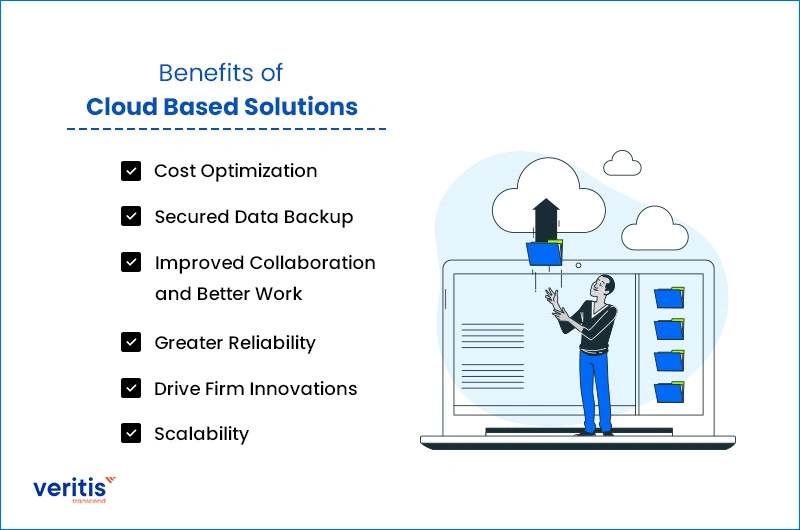
1) Cost Optimization
The financial case for cloud adoption is compelling. SMEs that migrate core workloads to the cloud eliminate the capital expenditure associated with purchasing, upgrading, and maintaining servers, hardware, and licensed software. Operating costs shift from unpredictable capital cycles to predictable monthly subscription models.
Cloud providers manage security patching, infrastructure maintenance, and system upgrades, responsibilities that would otherwise require dedicated internal resources. For SMEs with lean IT teams, this translates directly into reduced labor costs and fewer unplanned outages.
Cloud resources also accommodate demand spikes without requiring permanent infrastructure investment. A retailer managing seasonal volume surges, for instance, can scale compute capacity up and back down without overprovisioning year round.
For SMEs serious about controlling cloud spend, structured cloud integration and optimization practices, including usage alerts, idle resource management, and real time cost dashboards, ensure cloud economics stay aligned with business objectives.
2) Secured Data Backup and Disaster Recovery
Data loss is not just an inconvenience for SMEs; it can be existential. According to CloudRadar, a network outage costs organizations upward of $10,000 per hour. For a small business without a dedicated recovery infrastructure, the financial and reputational damage can be severe.
Cloud based solutions provide automated, geo redundant backups as a standard feature. Data is replicated across multiple locations, meaning a hardware failure, ransomware incident, or natural disaster does not result in permanent loss. Cloud providers can recover data from a lost laptop, restore systems after a breach, or roll back corrupted files ,at a speed and scale that on premises backup systems cannot match.
This level of resilience, previously available only to enterprise IT teams, is now accessible to SMEs through cloud based disaster recovery services. The key is ensuring backup frequency, recovery time objectives (RTOs), and recovery point objectives (RPOs) are defined before an incident occurs, not during one.
3) Improved Collaboration and Workforce Flexibility
According to Gartner, 74% of CFOs planned to transition at least 5% of their workforce to permanent remote roles. The pandemic accelerated the trend, but the underlying driver is productivity: distributed teams with cloud access consistently outperform those constrained by on premises systems.
Cloud based platforms give SME employees real time access to shared documents, project tools, and communication systems from any location and device. Files sync automatically. Version conflicts disappear. Teams in different time zones collaborate on the same data without friction.
For SMEs competing for talent in a market where flexibility is a differentiator, cloud infrastructure is not just an IT decision; it is a talent retention strategy.
4) Greater Reliability and Reduced Downtime
On premises infrastructure depends on hardware that ages, fails, and requires planned maintenance windows. Cloud infrastructure operates on a fundamentally different reliability model. Leading providers maintain uptime SLAs of 99.9% or higher, backed by redundant data centers, automatic failover, and 24/7 monitoring by dedicated engineering teams.
For SMEs, this matters because downtime is not just a technical problem; it is a revenue problem. A cloud provider’s dedicated operations team can detect and resolve issues faster than an SME’s internal IT staff, which is typically stretched across multiple priorities.
Cloud delivered services also support rolling updates that eliminate traditional maintenance windows, keeping business critical applications available when teams need them most.
5) Driving Business Innovation
An IBM Institute for Business Value study found that cloud based infrastructure gives SMEs the ability to enter new markets faster, expand product and service features, acquire new customers, and launch offerings at a pace that on premises systems cannot support.
Cloud consulting services provide SMEs with access to capabilities that were previously reserved for enterprises with large R&D budgets: machine learning APIs, advanced analytics, IoT integration, and rapid application development environments. These tools enable SMEs to prototype, test, and deploy new ideas in weeks rather than quarters.
SMEs that moved over 60% of their workloads to the cloud have achieved up to 11% year over year revenue growth compared to peers who remained on premises. Cloud based solutions also reduce product launch cycles by up to 65%, compressing the time between idea and market.
Businesses that delay cloud adoption are not just missing efficiency gains; they are ceding strategic ground to cloud native competitors who move faster and spend less per unit of output. Staying informed about cloud computing trends is critical for SMEs that want to remain ahead of the curve.
6) Scalability
Scalability is the defining characteristic of cloud computing, and the reason SMEs adopt it at an accelerating rate. Cloud infrastructure allows businesses to scale storage, compute power, and network capacity up or down based on actual demand, with minimal lead time and negligible downtime.
A traditional on premises environment requires SMEs to forecast capacity 12 to 24 months in advance and invest accordingly. Overestimate, and capital sits idle. Underestimate, and systems fail under load. Cloud eliminates that guessing game entirely.
For a growing SME, this means infrastructure scales with the business rather than ahead of it. New markets, new product lines, and new customer volumes can be absorbed without emergency procurement cycles or service degradation.
The 2026 Advantage: Cloud Metrics SME Leaders Should Know
For C-suite executives evaluating cloud investment, these data points establish the strategic context:
- Security leadership: 60% of C-suite leaders now cite enhanced security as the top benefit of cloud adoption, ahead of cost savings and scalability.
- Revenue correlation: SMEs with more than 60% of workloads in the cloud achieved up to 11% YoY revenue growth over on premises peers.
- Speed to market: Cloud based solutions reduce product launch cycles by up to 65%.
- Downtime cost: Network outages cost organizations over $10,000 per hour, a risk cloud based disaster recovery directly mitigates.
These are not aspirational figures. They represent documented outcomes from organizations that recognized the benefits of cloud computing and treated cloud adoption as a strategic priority rather than a tactical IT upgrade.
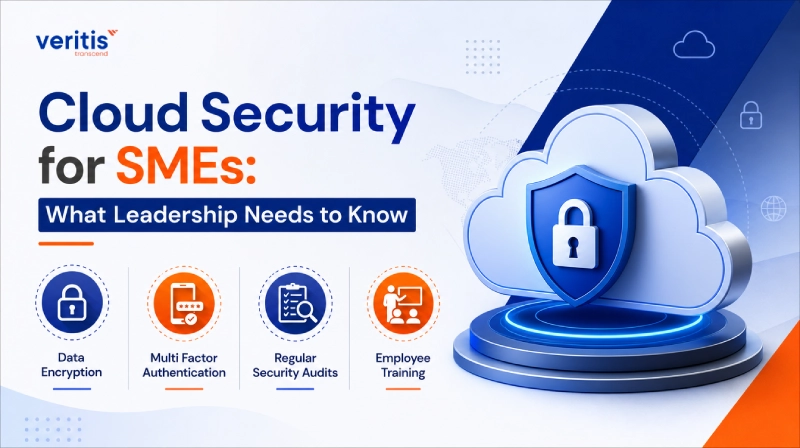
Cloud Security for SMEs: What Leadership Needs to Know
Cloud adoption introduces a shared responsibility model for security. The provider secures the infrastructure, while the business is responsible for its data, access controls, and configurations. Understanding that boundary is critical. The same principle applies to cloud cost optimization, where governance, resource management, and continuous monitoring play a key role in controlling cloud spending.
1) Data Encryption
All sensitive data, at rest and in transit, should be encrypted by default. Leading cloud platforms offer encryption as a standard feature, but SMEs need to verify that encryption is enabled for every workload and that key management practices meet their compliance requirements.
2) Multi Factor Authentication
Unauthorized access continues to be a major contributor to cloud security breaches. Multi factor authentication (MFA) is the most effective single control for reducing that risk. MFA should be enforced across all user accounts, not just administrator accounts.
3) Regular Security Audits
Cloud environments are not static. Configurations drift, permissions expand, and new vulnerabilities emerge. Regular security audits, conducted quarterly at minimum, identify exposure before threat actors do. Automated tools can continuously monitor misconfigurations and policy violations. For SMEs exploring how AI driven approaches strengthen cloud defenses, AIOps based cloud security practices offer a practical framework.
4) Employee Training
A single phishing click can undermine the most sophisticated cloud security stack. Security awareness training for all employees, not all about IT staff, is a nonnegotiable component of any cloud security program.
Useful link: How Digital Transformation in Finance and Accounting is Reshaping Business Operations?
Best Practices for Cloud Implementation
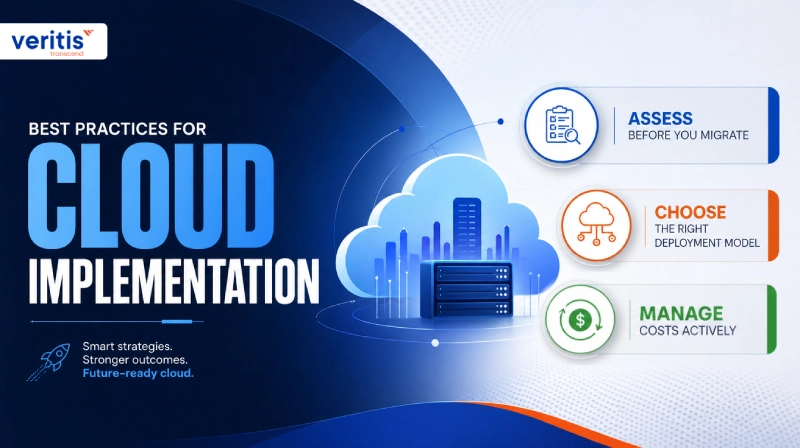
A successful cloud transition requires more than selecting a vendor. SME leaders should approach implementation with a structured framework:
1) Assess Before You Migrate
- Audit your current IT infrastructure and application stack
- Define compliance and data sovereignty requirements
- Evaluate integration dependencies with existing business systems
- Assess internal team capabilities and vendor support needs
2) Choose the Right Deployment Model
- Public cloud: Low cost, fast deployment, ideal for non sensitive workloads
- Private cloud: Greater control, suited for regulated data environments
- Hybrid cloud: Combines on premises control with cloud scalability
- Multi cloud: Distributes workloads across providers to reduce vendor lock in
3) Manage Costs Actively
- Set usage alerts and budget thresholds before go live
- Identify and decommission idle resources regularly
- Use showback and chargeback models to drive accountability
- Monitor spend through real time dashboards
For organizations considering a major cloud transition, reviewing common cloud migration failure points before committing to a migration plan can prevent costly missteps.
Case Study: Secure and Scalable Cloud Storage for a Petcare SME
Veritis partnered with a mid sized petcare enterprise facing a critical data management challenge. As the business scaled rapidly, its existing infrastructure could not support growing storage demands, compliance requirements, or remote access needs.
Veritis delivered a tailored cloud architecture that provided:
- Geo redundant, encrypted data storage ensuring compliance and integrity
- Role based access controls and MFA across all cloud applications
- Automated backup and disaster recovery with defined RTOs and RPOs
- Scalable infrastructure aligned to the client’s projected 3 year growth trajectory
The outcome: the client reduced data management overhead, eliminated unplanned downtime related to storage failures, and gained the confidence to scale operations into two new regional markets without additional infrastructure investment.
This is precisely what cloud based solutions are designed to deliver: not cost reduction, but the operational foundation for growth.
Conclusion
Cloud based solutions are not about a future consideration for SMEs; they are a present competitive requirement. The six advantages covered here cost optimization, data resilience, collaboration, reliability, innovation velocity, and scalability collectively define what it means to operate a modern, competitive small or medium enterprise.
The SMEs gaining ground in 2025 are those that treated cloud not as an IT project, but as a business transformation. They built on the right architecture, secured it properly, and continuously optimized their investment.
Veritis, a Stevie Award winning IT partner, delivers IaaS, PaaS, and SaaS cloud solutions to SMEs globally. From initial assessment through migration, optimization, and ongoing management, Veritis ensures your cloud investment translates directly into measurable business outcomes. Contact Veritis to discuss a cloud strategy built for your organization’s specific growth goals.